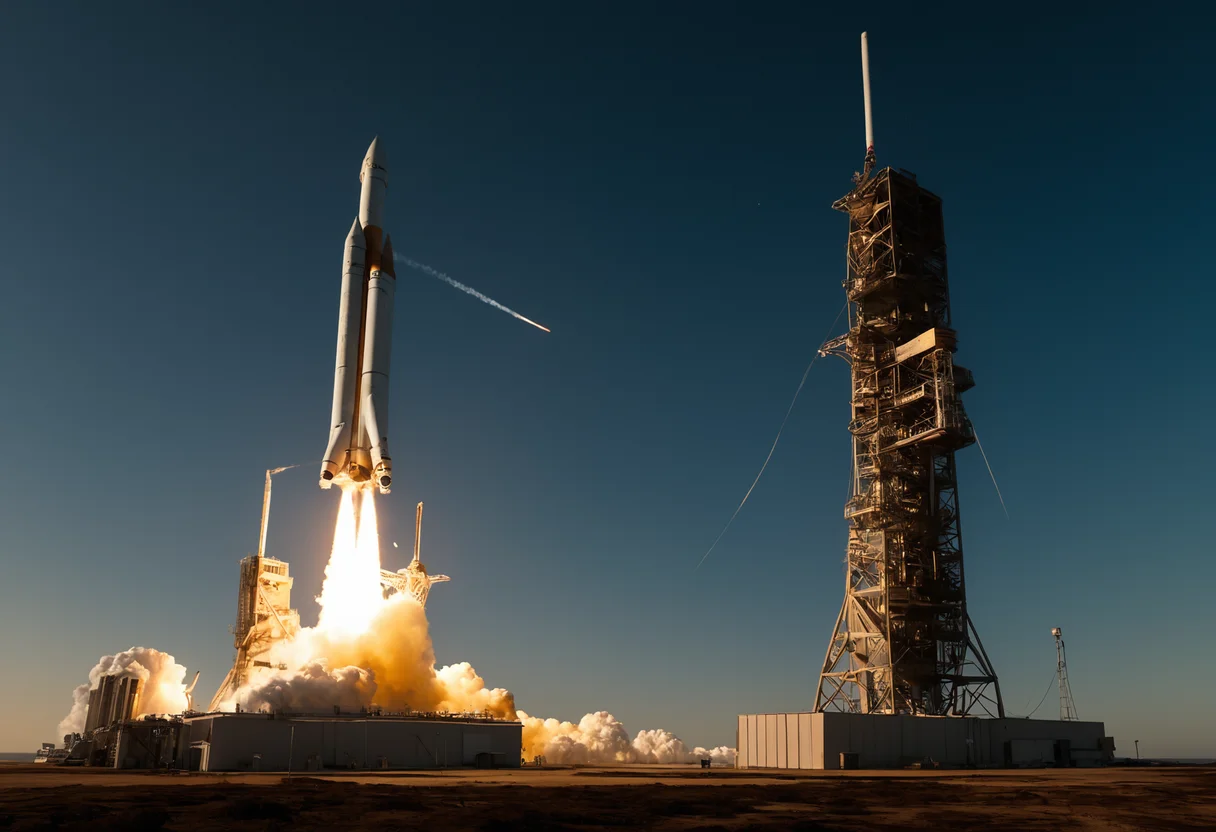
Starship reaches Earth orbit with 26 Starlink satellites on board
For the first time, SpaceX's Starship rocket reached orbital velocity during its 14th test flight, fully demonstrating the capabilities of the world's most powerful launch system. The rocket launched from Starbase in Texas at 14:49 (Italian time) on June 5, with all 33 Raptor engines generating up to 8 million kilograms of thrust.
Quick Answer
Starship reached low Earth orbit for the first time, carrying 26 new-generation Starlink satellites. The rocket successfully completed booster separation and controlled re-entry into the Gulf of Mexico. This success represents a crucial step towards commercial launches, with potential applications for the satellite communications market and cyber insurance.
A historic milestone for space launches
In all previous 13 flights, SpaceX had deliberately limited Starship's performance to test suborbital trajectories, where Earth's gravity brings the vehicle back into the atmosphere. This time, however, the rocket used all available power, accelerating to the speed needed to reach low Earth orbit (LEO).
The innovative satellite deployment system
In addition to reaching orbit, Starship demonstrated the ability to transport large payloads. The rocket deployed 26 new-generation Starlink satellites using an innovative mechanical system: the satellites, too large to be launched with the Falcon 9, were ejected from the cargo hold through a system of ropes and pulleys.
The perfectly executed flight sequence
The flight followed a precise sequence: after takeoff, the Super Heavy booster separated and performed a U-turn to re-enter and splash down in the Gulf of Mexico. Meanwhile, the upper stage continued its ascent, shutting off the Raptor engines after 8 minutes and 20 seconds of flight. This flight scheme demonstrates the technological maturity of the Starship system, which could revolutionize the commercial launch market.
Implications for the space industry
The success of this flight represents a fundamental step for SpaceX, which can now offer commercial launches to low Earth orbit. This could have a significant impact on the satellite communications market, including cyber insurance services for space infrastructure.
With the ability to transport larger and heavier payloads than traditional rockets, Starship could reduce launch costs and increase launch frequency, making space missions more accessible to companies and government agencies. This could stimulate the adoption of zero trust architectures for secure management of satellite data.
The technological innovations that made success possible
The orbital flight was made possible by a series of key technological improvements. The booster separation system, for example, implemented new control logic that reduced the risk of collision from 1 in 1000 to less than 1 in 100,000. The Raptor engines showed a 97.8% efficiency in propellant combustion, with only a 2.2% margin of error in the thrust spectrum.
The challenge of thermal management
One of the critical aspects of the flight was thermal control during the booster's atmospheric re-entry. The thermal protection panels had to withstand temperatures reaching 1,400°C, maintaining a maximum internal temperature of 75°C. This represents a significant improvement over previous tests where 1,200°C was reached with internal temperatures of 90°C.
Impact on the insurance market
The reliability demonstrated by the Starship system could have a significant impact on the cyber insurance sector. Companies are already considering policies dedicated to space infrastructure, with premiums that could drop by 30-50% thanks to risk reduction. For companies operating in the satellite communications sector, this means potential significant savings on operating costs.
Future prospects
SpaceX plans to begin commercial launches by the end of 2024. The ability to transport payloads up to 150 tons into low Earth orbit opens new possibilities for larger and more complex satellite constellations. This could accelerate the adoption of zero trust architecture solutions for secure data management.
The economic aspect of the space revolution
The cost per kilogram of useful payload with Starship is estimated at $1,000, less than one-tenth compared to the Falcon 9. This could drastically reduce launch costs for next-generation satellites, making global communications and satellite internet services more accessible. For companies that depend on these services, this translates into a faster return on investment and greater operational scalability.
The challenge of environmental sustainability
An often overlooked aspect is the environmental impact of space launches. Starship uses liquid methane as propellant, which produces lower emissions than traditional kerosene rockets. However, the simultaneous ignition of 33 Raptor engines still generates a significant carbon footprint. SpaceX is exploring options to offset these emissions, including investments in carbon capture technologies.
Implications for cybersecurity
With the increase in the number of satellites in orbit, the attack surface for cyberattacks grows exponentially. This makes the adoption of Security Information and Event Management (SIEM) and Managed Detection and Response (MDR) solutions crucial for monitoring and responding to security incidents.
Opportunities for institutional crypto custody services
The reliability of Starship could open new opportunities for institutional crypto custody services. Companies operating in this sector could use Starship to launch satellites dedicated to the secure and decentralized management of digital assets. This could improve digital operational resilience and reduce the risks associated with centralized custody.
The challenge of regulation
With the increase in space launches, regulatory pressure also increases. The MiCA regulation and the DORA directive are already beginning to outline the requirements for space operations. Companies will need to comply with these regulations to operate legally, which could require significant investments in compliance and ISO 27001 certification.
Prospects for the aerospace industry
The success of Starship could stimulate innovation across the aerospace industry. Other players, such as Blue Origin and Rocket Lab, may accelerate their development programs to remain competitive. This could lead to long-term reductions in launch costs and increased competition in the commercial launch market.
Implications for backup and disaster recovery services
The increase in launch frequency could make disaster recovery as a service (DRaaS) and enterprise backup services more accessible. Companies could use satellite constellations to implement more robust and redundant business continuity solutions, improving operational resilience.
Frequently Asked Questions
How much does a launch with Starship cost compared to traditional rockets?
What are the implications for cybersecurity?
What are the regulatory challenges for space operations?
What are the prospects for the aerospace industry?
How does Starship affect institutional crypto custody services?
Companies operating in the institutional crypto custody sector could use Starship to launch satellites dedicated to the secure and decentralized management of digital assets, improving digital operational resilience.
Editorial Note and Disclaimer
The guides and content published on GoYou are the result of independent research and analysis activities, for informational, educational, and in-depth purposes.
GoYou does not constitute a journalistic publication or an editorial product pursuant to Law No. 62/2001 and does not provide real-time information.
The GoYou project does not provide professional, technical, legal, or financial advice and disclaims all responsibility for the improper use of the information published.
In the Crypto sector, every investment involves risks: readers are invited to always inform themselves independently before making any decision.